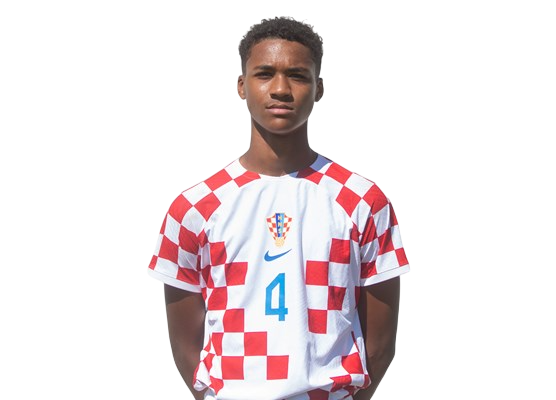
Fifteen years old. 1.85m. Left-footed. Playing U17 football with the calm and spatial intelligence of someone three years older. With big clubs circling, the question is not whether the ceiling is real, it is whether anyone can afford to be patient enough for it to arrive.
Anticipation is the headline quality. He reads movement before it happens — identifying the run, cutting the passing lane, stepping to intercept rather than waiting to react. This is a cognitive trait, not a physical one, and it is already more developed than most defenders produce at this age. The 72.7% defensive duel win rate across youth competition is partly a product of it: he is already positioned correctly when the duel begins.
Intelligent switching between defensive modes. He does not default to one defensive posture. Front-foot pressing when the trigger presents itself; back-foot delay when the situation calls for patience. At 15, that context-sensitivity is genuinely uncommon. Most defenders at this level either press everything or retreat from everything.
Physically dominant for his age group. 1.85m with a frame that is already developed beyond his peers. He uses size cleverly in the box — blocking angles, shielding, winning aerial balls — without relying on it exclusively. The physical edge will narrow as peers catch up; the anticipation will not.
Defends in front of the box, not just inside it. He steps out to engage challenges in the space in front of the defensive line rather than retreating towards the goal. This requires confidence in his own read of the game — a defender who goes wrong here concedes. He goes right more often than not.
Composure on the ball is immediately visible. He does not panic in possession. Receives calmly, takes his touch, and plays — without the hesitation that affects most defenders his age when pressed. 80.5% pass accuracy in youth competition is a meaningful number at this level.
Willing to carry into midfield. He does not treat the halfway line as a ceiling. When space opens, he drives forward with purpose and looks comfortable in possession further up the pitch — a product of the technical quality that is already present, not just size.
Long passing range is developing but inconsistent. He attempts diagonal switches and balls over the defensive line with ambition. The execution is unreliable — 33.3% accuracy on long passes in the Wyscout sample. The vision is clearly there; the execution needs another eighteen months of deliberate work before it becomes a weapon rather than a risk.
Close control dribbling is situational. He shows the technical quality in moments — carrying out of pressure, shifting the ball past a press — but does not back himself consistently. The technique is present; the confidence to use it routinely is still forming. This is normal at 15 and will develop naturally as the frame fills out and the environment becomes more challenging.
At 15, trait classification carries more uncertainty than at any other point in a player's development. Physical attributes are still transforming. Technical habits are still forming. What is classified here as Pure DNA is what has already shown up consistently across multiple competitive contexts — for a player this age, that bar is already meaningful.
At 15, development priorities are not about fixing problems. They are about building the habits that will matter when the environment gets significantly harder.
Long pass execution — closing the gap between vision and delivery. He is already attempting the diagonal switch and the ball over the defensive line at a rate that tells you the picture is formed before he plays it. The 33.3% accuracy tells you the delivery mechanics are not yet consistent. The specific work is not on reading the pass — that is already there — but on the striking technique and body shape at the moment of contact. At a top academy, this is coachable and fixable. The urgency is that the same pass that looks like ambition at 15 looks like a liability at 18 if the accuracy has not caught up.
First-step explosiveness against pace — the specific coordination gap. He covers ground well at top speed. What he does not yet do is accelerate quickly from a standing start when a quick attacker runs directly at him. This is partly physical — the nervous system and fast-twitch muscle development of a large frame takes longer to mature — and partly technical, in that the correct defensive body shape for managing pace has to be trained deliberately. A top academy will address this structurally. The risk is the window between his current level and senior football, where opponents with genuine pace will find and exploit this before it resolves.
Trusting the carry — converting a situational quality into a default habit. When he drives forward out of the defensive line, the technical quality is visible and the decision to do it is usually correct. What is missing is the consistency — the automatic reach for the carry as a first option in space, not a secondary one after checking for the simpler pass. This is a confidence habit rather than a technical deficit, which means the right environment accelerates it faster than specific technical work. A system that rewards the carry and penalises the passive pass-back is what will unlock this part of his game.
Engaging attackers in the space in front of the line — not just inside the box. The box-defending is already mature. What he needs is more deliberate practice engaging challenges in the twenty to thirty metres in front of his defensive line, where the step-out requires reading the ball's trajectory, timing the press, and winning the action without either over-committing or under-committing. He does this in moments. It needs to become the default behaviour under competitive pressure at the next level, not something he produces when the situation is obvious.
These numbers are from five matches across U15 and U17 youth competition — not a statistical population to be percentile-ranked, but observed outputs that can be read as directional signals. They are presented as facts, not comparisons.
The interception volume relative to the duel volume is the clearest statistical signal of the anticipation quality described by scouts. A defender who intercepts nearly 5 times per 90 is not reacting — he is reading.
The gap between overall pass accuracy (80.5%) and long pass accuracy (33.3%) is the single most important data point. He has the vision and the courage to attempt the ambitious ball. The execution gap is the development target — it narrows with age and repetition, not with technical rebuilding.
There is a specific type of young defender that top clubs identify early — not the one who dominates physically at youth level, because that advantage disappears — but the one whose brain is already operating at a level his body has not yet caught up with. Kanté is that type. At 15, in U17 competition against opponents two years older, he does not defend with his legs first. He defends with his eyes. By the time his legs are required, he has already made the decision. That is not a physical attribute. It is a cognitive one, and it is the hardest thing to develop in a young defender because it cannot be drilled — it can only be experienced and gradually refined. At 15, it is already present.
The image that has stayed with me is this: a defender who moves like a grown man operating inside a body that is still becoming one. The gazelle comparison is accurate but incomplete. Gazelles are all legs and instinct. What Kanté has, unusually, is the calm that usually only comes after ten years of professional football — that quality of not rushing, of letting the game come to him, of knowing where the ball is going without needing to react to it. Paired with a physical frame that will keep growing for another four or five years. The gap between the cognitive maturity and the physical ceiling is enormous. He is, right now, a 25-year-old brain inside a 15-year-old body that has not finished building itself yet.
The interception volume, nearly five per 90 in youth competition, is the data expression of that brain. A player who intercepts at that rate is not guessing and getting lucky. He is reading the pass before it is played, positioning to cut it off, and executing cleanly enough to complete the action. Nearly 10 ball recoveries per 90 in the opponent's half says he is not sitting in his defensive line waiting for the game to come to him. He is hunting it. The long pass accuracy at 33.3% is the honest counterweight: he has the vision to attempt the ambitious diagonal, he does not yet have the consistent execution to make it a weapon. That gap is not a character flaw. It is age. The vision is always ahead of the execution at 15. What matters is that the vision is there.
What makes him interesting is that his bet is a good one. You are not projecting traits that are not there. You are projecting the continuation of traits that already are. The patience question is real, because this is not a profile that needs to be rushed. It needs to be allowed to develop without interference. In the right environment, that is a strength. In the wrong one, it becomes a risk.
What I keep returning to is the transition risk. He is a 15-year-old with Bundesliga giants involved, being asked to leave his home country, his language, and the environment that shaped everything he currently is — before he has even had a professional contract. That is not a small thing. The composure he shows inside a football pitch is a promising signal about how he might handle it. But the players who navigate that transition well are the ones with the right people around them, not just the right psychology. This is worth watching as closely as the football.
Risk at this age is assessed differently than for senior players. The question is not current output but developmental probability — how likely is each risk factor to derail the trajectory rather than just slow it.
The cognitive qualities — anticipation, composure, spatial reading — are already formed and are the least likely to regress. The physical development has years of runway. The technical gaps are age-appropriate. There are no red flags in the development profile.
Calm and level-headed in competitive contexts already. The leadership markers at 15 are a positive signal. The more relevant psychological risk is the transition to a major academy environment — navigating that at 15 with elite clubs involved requires family and professional support, not just personal composure.
Dortmund, Bayern, Salzburg, Hoffenheim, and Italian clubs confirmed. The market has already found him. There is no valuation risk — the question for Lokomotiva Zagreb is maximising the outcome of an inevitable departure, not whether the interest is real.
Moving to a top academy at 15 is the correct development step — the competitive level at Lokomotiva U17 will not continue to challenge him at the rate required. The low risk is that the transition itself — new country, new environment, new language — is managed well. This is a family and club responsibility, not a football one.
The market has found him for a reason that is not hard to see once you watch him. The physical profile is obvious — 1.85m, already strong, with years of physical development ahead — but physical profiles at 15 are everywhere. What is not everywhere is a 15-year-old left-sided centre-back who reads the game with the calm and spatial clarity he shows consistently. The clubs involved are not here because of a good press release from his academy. They are here because their scouts watched him read a movement before it happened, step to cut the passing lane, and complete the interception without breaking stride — and then saw him do it again in the next match. The transition to a top academy environment is the correct next step. The competitive level at Lokomotiva U17 will not continue to challenge him at the rate he requires. He is not ready for senior football. He is ready for the best development environment available.
A 9 at 15 reflects a specific and honest assessment: the cognitive and technical foundation already present, combined with the physical runway still ahead, makes a top-five European league starter the base-case outcome — not the ceiling. The deduction from a 10 is the appropriate uncertainty that accompanies any projection made five years before professional debut. He is one of the top 2010-born centre-backs in Europe. The clubs involved already know this.