Teenage centre-backs are supposed to be incomplete. Nikola Simić is not. The statistical profile is unusually complete. The question is no longer whether he becomes a professional defender. It's how high his ceiling goes and whether he is a future top-level centre-back or simply a very good one.
96th-percentile pass accuracy, 88th-percentile passes per 90. The passing volume is high and the quality is elite. He is not a safe recycler hiding from the ball. He receives often, in tight areas, and almost never gives it away. The short-medium accuracy and the long ball accuracy both sit in the elite band together, which is the combination that tells you the range is genuine rather than selective.
CIES ranked first globally among U20 CBs for opponents bypassed per 90. Across 46 top domestic divisions. This is not a Serbian Super Liga number; it is a global number. The mechanism that produces it is carrying through press and playing line-breaking forward passes at elite volume and accuracy.
95th-percentile dribble success rate. For a centre-back, this is the profile's most unusual data point. It hints at composure rather than athleticism: he does not dribble to escape danger, he dribbles because he has already assessed the situation and committed to a controlled exit. Young CBs who complete dribbles at this rate are comfortable manipulating pressure before it arrives.
Forward passes at 94th percentile, passes into final third at 90th. He plays early and plays forward. The build-up contribution is not just circulation. He is consistently finding the pass that breaks lines or advances territory. That is the technical and cognitive quality that makes him a genuine possession asset rather than a ball-secure recycler.
Steps into midfield when the structure invites it. Not a compulsive carrier but a selective one. When the line opens, he commits to the advance and plays the next pass from there. The positional reading that governs those moments is already well above what the age would predict.
93rd-percentile duels won, 90th-percentile defensive duel win rate. Wins his individual contests at an elite rate. The mechanism is composure and positioning rather than aggression: he waits for the right moment, stays on his feet, and forces the attacker into a losing position before committing to the challenge. Almost never gets beaten by the first touch.
Defensive action volume is modest at the 7th percentile. This is the number that confuses people who read left to right through a dataset without thinking about it. Low defensive action volume at Partizan does not mean passive defending. It means the team concedes few dangerous positions, and when they do, Simić has usually already cut the situation off before it fully developed. Positioning prevents the action from being required.
74th-percentile aerial duel win rate, 65th-percentile aerial duels won per 90. Good rather than dominant aerially. At 192cm the volume and win rate should both be higher eventually. The quality in contested moments is there. The assertiveness in seeking out aerial contact is the development question at the next level.
Covers channels with intelligent positioning rather than reactive recovery. Channel coverage at Partizan is a genuine tactical demand. He reads runs early, positions his body to cut the angle before the ball is played, and rarely needs the sprint recovery because the problem was already solved positionally. The recovery pace is there when needed; the positioning means it rarely is.
Cards at the 92nd percentile and fouls at the 86th. This number requires context. He is not a dirty player. He is a player who competes for the ball rather than hanging back. The discipline within those contests is high: the fouls are contested ground duels, not late challenges or cynical interventions. It is an engagement marker, not a conduct concern.
Aerial assertiveness and volume. The quality in contested aerial moments is already there. What needs to develop is the instinct to seek those moments out rather than allowing them to arrive. A 192cm centre-back who actively attacks aerial balls is one of the most physically imposing defensive presences in the game. He is not yet that player. He can become it with deliberate work on aerial aggression and jump timing.
Pressing resilience under sustained coordinated pressure. The composure when pressed has been described as decent rather than elite. Top-five league build-up phases involve continuous, coordinated pressing without the recovery windows Serbian domestic football provides. Accumulated exposure to high-press systems will sharpen this. It is not a technical problem. It is a tempo and reading problem that repetition resolves.
Developing a more proactive stepping profile. Currently defends with composure and stability. The qualities to become more assertive in stepping to win the ball forward are already present in the duel numbers. A system that specifically asks him to step and disrupt in transition would accelerate this dimension. It is a contextual development question, not a ceiling one.
The composure, the passing range, the duel quality, and the positional intelligence are already functioning at a level that belongs in the top-five leagues. They are not products of a weak domestic league. They are tested at Partizan, which is a genuine European-level club environment in terms of demand and scrutiny.
The 8 reflects two honest gaps rather than fundamental barriers. First, the aerial assertiveness question: the win rate is good, but a top-five league will test the volume commitment more aggressively than Serbian football has. Second, the pressing resilience under sustained coordinated press: it has not been stress-tested at the frequency a top-five league demands. Both are developmental gaps, not structural incompatibilities.
The Bundesliga is the natural destination for this profile. The technical and positional demands suit the passing quality and duel composure. A mid-table Bundesliga club with a possession-dominant system would extract the profile immediately. Serie A or La Liga offer similar structural fits. The Premier League's physicality is manageable given the frame; the immediate pressing intensity is the adaptation challenge.
Each axis scored 1 to 5, where 1 is minimal risk and 5 is extreme risk.
The core technical and cognitive habits are already formed at 19 with nearly 3,000 senior minutes. The development gaps are developmental enhancements, not structural repairs. The trajectory is one of the clearest in this database.
Regular Partizan starter, Serbia U19 international, described by multiple sources as playing beyond his years. The maturity and composure markers are consistent across all sources and contexts.
€5M with contract to June 2029. No agent. The price is already moving given the CIES visibility and Partizan's transfer track record. The window for acquiring at current value is narrowing.
The profile is readable across multiple defensive systems. Ambidextrous. Comfortable in a back four or back three. The only meaningful constraint is a highly direct, aerial-intensive system that suppresses the build-up quality that defines the profile.
The profile almost looks disappointingly quiet until you realise what you are actually looking at. No absurd defensive action numbers screaming at you. No hyper-aggressive stepping profile. No giant progression volume. If you scout centre-backs mainly through "how much stuff happened around them," you might leave the dataset slightly underwhelmed. That is not a problem with the player. It is a problem with the reading.
Expected threat via live passes measures how much attacking danger his passing sequences generate directly. For a centre-back, this is a more honest measure of build-up impact than assist numbers: it captures the passes that advance play into threatening zones regardless of whether a goal results.
Partizan's dominance means Simić receives the ball in comfortable positions, plays it forward accurately, and the threat is generated further up the pitch by attackers. His xT contribution is distributed through sequences rather than concentrated in his own actions. That is exactly what a build-up CB is supposed to do. The number undersells the contribution for the same reason the defensive action volume does: he is operating within a team structure, not despite it.
The thing that stops you when you watch him is not a moment of defensive brilliance. It is the absence of moments where he looks like he needs to produce one. The game around him does not generate the kind of crisis that other teenage centre-backs spend their time firefighting. He reads the run before the ball is played, positions himself to cut the angle, and the danger dissolves without requiring a tackle, an interception, or a last-ditch intervention. He is spending the game preventing problems rather than solving them. Those are not the same skill level.
The passing profile is the part that does not look like a Serbian Super Liga teenager. 96th-percentile accuracy. 94th-percentile forward passes. He plays early and he plays forward and he almost never gets it wrong. The ambidexterity compounds this: there is no predictable pressing trigger because there is no weak side. Any press that wants to force him onto his right foot and make him uncomfortable simply does not work. That removes one of the primary tools defences use to press centre-backs.
The CIES number is the one that should make people pay attention. First in the world among U20 centre-backs for opponents bypassed per 90, across 46 top domestic divisions. Ahead of players in more demanding leagues worth multiples of his current valuation, with far more pressing attention from scouts and analytics departments. The methodology measures dribbles and passes that leave opponents behind. Simić leads the global cohort by a margin. That is not a Serbian Super Liga artifact.
The open question the profile leaves is whether he eventually becomes more proactive or remains primarily a stabiliser. Right now he defends with composure and structure rather than assertive stepping. The qualities for a more front-foot defensive profile exist in the duel numbers. Whether the context at Partizan, or the manager at his next club, asks him to develop that dimension is genuinely unclear. It matters less than people might think for a player whose passing range already puts him in the top tier globally for his position and age. A great stabiliser is an extremely valuable asset regardless. The proactive ceiling would simply make the profile exceptional rather than very good.
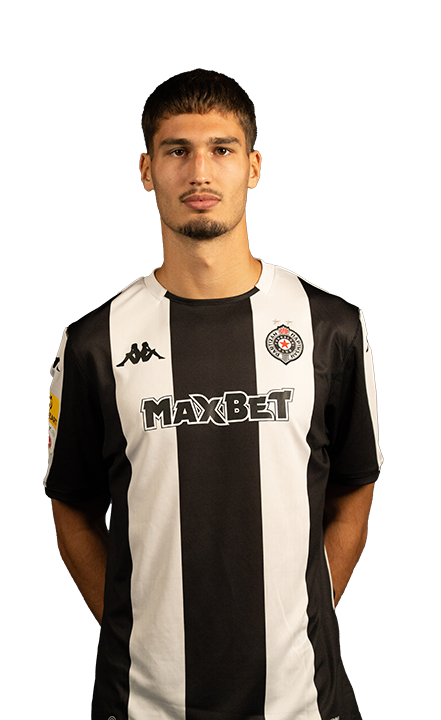
Buy the composure, the passing range, the duel quality, and the reading of the game. Those are already functioning at a top-five league level in a European club context. The aerial assertiveness and pressing resilience under sustained coordinated press are the adaptation challenges, not structural barriers. At €5M with a 2029 contract and no agent, this is the most straightforward acquisition case in the Serbian dataset.
A first-choice centre-back at a Champions League club within four years. The technical and cognitive foundation is already present at a level that very few 19-year-old centre-backs in European football can match.