Kosovo's pool is not France's pool. That is not an excuse to look away. A 17-year-old producing shots, box touches, progressive runs, and a defensive bite that embarrasses most senior wingers in the same dataset, at a club pushing for European football, is not a coincidence. The mechanism is unfinished. The appetite is not.
The profile is jagged. That is what makes it interesting. The numbers that point toward genuine threat and the numbers that point toward unfinished business are both real and both present simultaneously. This section names both without resolving the tension prematurely.
The game is already pointed toward goal. Shot volume, box presence, and conversion above expectation together describe a player whose instincts already belong in attacking areas. That kind of forward orientation is harder to teach than technical refinement.
The defensive bite is real. 84th-percentile defensive actions and 87th-percentile sliding tackles for a teenage winger is not a coincidence. He presses forward and tracks back with the same intensity. That quality tends to make coaches trust young players with minutes before their technique justifies it.
He is left-footed on the right. The natural cutting mechanism that produces his best attacking moments is already embedded. It does not need to be taught, only sharpened.
Already playing for Kosovo's U20 side at 16. He was U17 captain. The character markers that come with being trusted with senior and above-age minutes at this early a stage are not nothing.
The dribble success rate is the urgent problem. 10th percentile means that the 1v1 carrying that is central to the profile's identity is failing more than it is succeeding in this league. Better defences compress faster. This needs to resolve before the next step makes sense.
Head position during carries. Multiple observations flag that he loses sight of teammates during dribbles. The vision and the carrying are not yet connected. When they are, the creative numbers will move.
The final ball weight and timing. Whether crossing from wide or playing through balls, the execution is uneven. The intent is clear; the delivery does not always match it.
Physical robustness. Not the strongest in aerial or ground duels. At 181cm the frame is there to grow into. But the current duel numbers reflect a player who competes without yet dominating.
Dribble efficiency and head position during carries. These are the same problem expressed differently. The technical execution of the carry needs to improve, but the more fundamental fix is learning to carry with his head up so that the decision after the carry is available before the defender has committed. Once the vision and the carrying are connected, the creative numbers will follow almost automatically.
Final ball weight and timing. The technical imagination is already ahead of the execution. He sees the right pass. The delivery does not always arrive with the right weight or at the right moment. Deliberate repetition of crossing, through-ball, and cut-back delivery under match-speed conditions is the specific work. This is a repetition problem, not a vision problem.
Physical robustness and aerial application. The frame at 181cm is there to grow into. Senior defenders will target the aerial ball and the physical contest deliberately. Strength work over the next two seasons and specific aerial challenge practice will address both. Neither is a structural ceiling. Both are currently active limitations at the next level.
Exposure to a better competitive environment. The Kosovo Superliga is not the context that resolves the development questions this profile raises. A step toward a developing Balkan or Central European league, or a strong youth competition at a higher-level club, would compress the timeline for understanding whether the tape-level qualities genuinely scale.
The 4 reflects a specific and honest position: the attacking instinct, defensive engagement, and psychological confidence are qualities that belong at a higher level than Kosovo football. They are not products of a favourable context. They are already present in the playing style itself.
But the dribble success, the creative output, and the physical robustness are all genuinely limiting at this moment. A step directly to a top-five league or even a competitive mid-tier league would expose those gaps before the profile has had the environment to close them. The right next step is a developmental context, not a performance context.
The Jupiler Pro League or a mid-table Eredivisie club represents the highest credible immediate next environment. Anything above that asks the physical and technical profile to be something it is not yet. A developmental move within the Balkans or Central Europe in the near term would be the right step before that conversation becomes relevant.
Each axis scored 1 to 5, where 1 is minimal risk and 5 is extreme risk. These scores carry an explicit caveat: they reflect a 17-year-old on limited senior data in a developing league. They are more speculative than any other report in this database.
The dribble success and creative output are genuine gaps. Whether they resolve with development is the central unknown. Technical habits at 17 are not yet fully formed, which cuts both ways.
U17 captain, U20 inclusion at 16, European goal at 17. The character indicators are already strong and have been tested in environments above age expectation.
€200k with no contract end date and no agent. Acquirable for developmental purposes without competitive pressure. The acquisition cost is negligible relative to the ceiling if development follows.
The profile requires a system that gives him freedom to carry and cut inside while developing the technical output gaps. Drop him into a rigid defensive structure or a physical midfield battle and the profile disappears.
The first thing the tape settles is the dribble success question. The data says 10th percentile. The eye test says something more complicated. He attempts difficult actions constantly: body feints, aggressive touches, directional shifts, sudden cuts inside from the right, half-space carries, moments where the game visibly bends toward him. Defenders react early. Midfields collapse toward the ball. The profile creates instability. What the tape also shows is that the head goes down during carries, and when that happens, he dribbles into positions rather than through them. That is a different problem from failing technically in a good position. The fix is about awareness before it is about technique.
The more interesting observation on the tape is not in the dribbling at all. It is in the moments where the game suddenly slows around him. There are sequences where younger attackers usually cannot manufacture this kind of thing: defenders begin reacting to the possibility of the action before the action itself fully arrives. That is not athleticism. That is something else. It does not show up reliably in the data at this stage, and the inconsistency is real, but the moments where it appears are the reason this profile is worth writing about at seventeen.
The profile already contains the traits that are genuinely hard to teach later: bravery in possession, willingness to receive responsibility, confidence attacking defenders repeatedly, comfort operating between lines, the instinct to move play toward danger rather than safety. Too many young attackers look tidy without ever actually threatening the structure of the game. Ahmeti already threatens structures. The refinement comes later. That sequence, danger first, polish second, is usually better than the reverse. You would rather teach control to a player whose game already moves toward goal than teach goalward instinct to a tidy technician.
There is also a broader contextual point about Kosovo's talent ecosystem. The pool is not France, England, or Serbia. But Ahmeti was already playing for Kosovo's U20 side at sixteen and captained the U17 side before that. Players do not accidentally become centralizers in national setups that early, regardless of the pool size. There is a reason people around Kosovo football already speak about him differently. The underlying feeling watching him is not "finished player." It is "future attacking reference point." The profile is still volatile, incomplete, and occasionally overaggressive technically. Those are seventeen-year-old problems, not permanent ceiling markers.
The largest unresolved question is whether this eventually matures into a true high-level creator or a more direct chaos-winger hybrid. The passing imagination, carrying aggression, and movement suggest one pathway. The inconsistent execution and lower-volume circulation suggest another. That question does not need to be resolved now. A developmental club should be tracking this and making a move before the profile becomes cleaner and considerably more expensive.
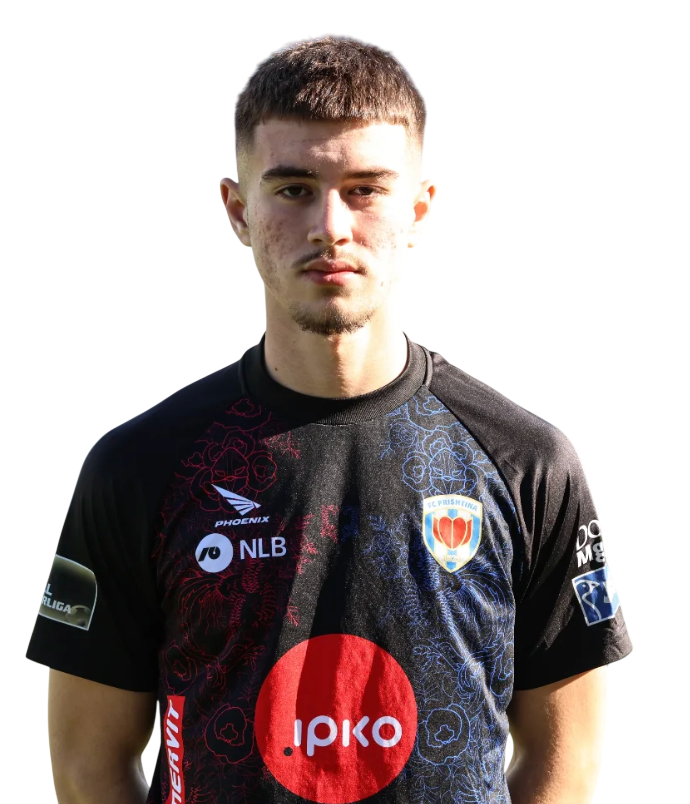
This is a watch-list report, not a transfer recommendation. The data establishes a teenager with genuine attacking instinct, unusual defensive engagement, and a profoundly unresolved technical question at the centre of the profile. The dribble success needs the tape. The creative output needs a stronger environment to distinguish talent from context. Track him through the summer. If a developmental move materialises, revisit. If he stays in Prishtina for another season, the next dataset will be far more instructive than this one.
A ceiling of a first-choice inside forward at a top-flight European club is plausible if the dribbling and creative output develop to match the attacking instincts already present. This is the most speculative potential rating in the database. It reflects what the appetite, the defensive engagement, and the attacking instinct suggest is possible, not what the current mechanism guarantees.