88th-percentile long pass accuracy. 14th-percentile defensive duel win rate. He wins the ball without winning duels and progresses without carrying. That specific paradox is either a serious problem or a very interesting midfielder. The tape makes the case for the second.
The distribution range is the headline quality. 88th-percentile long pass accuracy, 10th-percentile lateral passes. He is structurally biased toward forward and vertical. Daisycutters, lofted diagonals, outside-foot switches, one-timers — variety in the execution, consistent in the direction. Not a player who gets the ball and turns around.
Builds from the back intelligently. Drops between the centre-backs to receive, turns under pressure with composure, plays into midfield or directly into the channels. The third-man principle and one-touch combinations both appear on film. The close control is functional rather than exceptional — the ball does not always sit cleanly at his feet — but the decision under pressure is consistently sound.
Generates real goal threat for a DM. 73rd-percentile non-penalty goals, 80th-percentile npxG. The shooting motion is powerful and the on-target rate is elite for the position. He chooses moments carefully rather than arriving randomly — 68th-percentile touches in the box is above average without being constant. The rocket shot occasionally appears and it is convincing.
Rarely carries. 19th-percentile progressive runs. This is the direct data expression of a midfielder who manages territory through passing rather than movement. Acceleration is moderate. The compensation is distribution quality and positional intelligence. Whether that trade-off works at a higher tempo depends entirely on the system around him.
Screens through positioning, not physicality. 92nd-percentile pAdj interceptions alongside a 14th-percentile defensive duel win rate. He is reading the game early, stepping into passing lanes, and stealing possession before contact is required. The anticipation is doing the defensive work that the body would struggle to do alone. The question at the next level is whether opponents are more patient — waiting him out rather than playing into his reads.
Robust in the body when contact arrives. Strong, uses his frame, wins duels in the physical sense even when the percentage says otherwise. The duel win rate discrepancy is partly a product of difficult ground duels he enters — not passive avoidance. He is competitive in contact. The issue is frequency of success rather than willingness to engage.
Box defending is effective. 82nd-percentile shots blocked. The defensive activity inside the penalty area is above average — he reads when to tuck in and protect the shape, and he does it consistently. Not a trait that gets discussed with DMs but it shows on film.
Gets emotionally heated. Leadership mentality that occasionally tips into over-intensity. Not a disciplinary problem — the card rate is moderate — but the emotional temperature rises in tight moments. At higher levels that edge needs to be managed rather than suppressed, because the competitive drive is part of what makes the captaincy credible.
What each trait does when the level, system, or opposition changes around him.
Defensive duel win rate. 14th percentile is the most obvious gap in the profile and the first thing opponents at the next level will target. Improving the success rate in direct physical contests — particularly the timing of engagement and body positioning at the moment of contact — is the defensive development priority. The instinct to contest is present; the efficiency in winning them needs to improve.
Close ball control under press. The first touch is functional, not reliable. In a higher-press environment where opponents win the ball back from imperfect touches, this becomes a recurring exposure. Technical training in tight-space receiving — particularly the directional first touch that sets up the next action — would meaningfully raise the ceiling.
Emotional regulation in high-stakes moments. Not a character problem. A management task. The competitive intensity is an asset that occasionally becomes a liability when emotional temperature rises and decision quality drops. A coaching environment with explicit feedback on this will benefit him more than one that simply accepts or ignores it.
Progressive carry range. Not urgent, but worth developing. A midfielder who can advance with the ball in addition to distributing it closes off pressing angles that currently work against him. Even modest improvement in progressive carry frequency — not dramatic — would make him significantly harder to press aggressively.
The distribution range, interception reading, vertical orientation, and leadership quality travel. The defensive duel rate, limited carry ability, and moderate athleticism do not disappear; they become more consistently tested. The profile needs a system that compensates for the physical gaps and rewards the distribution intelligence.
7 rather than higher reflects one honest concern: unlike a CB whose physical dominance travels easily, a DM who defends through positioning is more system-dependent. Remove the structural cover, the Partizan organisation and the double pivot partner, and the gaps become more visible. The next club needs to understand what they are buying and build around it accordingly.
The Bundesliga is the fit. Specifically, a structured double-pivot where the positional reading and distribution quality is protected by a physically dominant partner. The carrying gap is also less punishing in a system with wide runners who reduce the distance the DM needs to cover with the ball. Serie A's tactical discipline and possession structures also suit. A high-press Eredivisie club that expects its DM to carry vertically would expose him faster than either.
Each axis scored 1 to 5, where 1 is minimal risk and 5 is extreme risk.
2,697 senior minutes at 20 for a title-contending club, club captain, called into senior international squad. Strong upward trajectory. The physical development gap is real but manageable at this age. Gaps are coachable rather than structural.
Captaincy trust is the strongest psychological signal available at this level. The emotional over-intensity in difficult moments is a management task, not a character problem. Broadly coachable with the right environment and explicit feedback.
€6M at 20 with contract to 2030. Reasonable for the profile and age. No aggressive market pressure flagged. The main risk is that the physical gaps suppress interest from clubs that cannot read past the duel rate percentile without watching the tape.
The most significant axis. He needs a structured double-pivot, a physically dominant partner alongside, and a system that protects the physical gaps while utilising the distribution intelligence. The wrong system — high-press, transition-heavy, DM expected to carry vertically — exposes the profile quickly.
92nd-percentile interceptions. 14th-percentile defensive duel win rate. 88th-percentile long pass accuracy. 10th-percentile lateral passes. The numbers describe someone who defends without duelling and progresses without carrying. Understanding why those pairs coexist is the entire profile.
Dragojević is the kind of midfielder modern football simultaneously underrates and becomes quietly dependent on. The profile is not explosive. Not aesthetically dominant either. He is not gliding past three players in midfield or covering thirty yards in transition like some genetically engineered pressing machine. In fact, if you build your evaluation entirely around duel win percentages and carrying volume, you will probably convince yourself there is nothing here.
But that is why we watch matches and do not solely rely on data.
Because the game keeps bending toward him anyway. The interceptions are not random. Neither is the captaincy at twenty for Partizan. Twenty-year-olds do not inadvertently end up as captain for a Serbian side vying for the title. They do not accidentally end up constantly receiving the ball in buildup while also constantly arriving in the right place defensively. The common denominator is usually processing speed. He sees situations early. That matters more than people want to admit when discussing defensive midfielders, because modern football culture has become slightly obsessed with visible athleticism. Recovery pace photographs well. So do violent duels. Midfielders sprinting forty yards to clean up problems they helped create in the first place tend to look impressive on clips. The quieter reality is that the best holding midfielders often prevent the emergency before it exists.
That is the tension with Dragojević. The duel numbers are bad. They are not fake-bad either. Better athletes will absolutely try to isolate him physically at higher levels and there will be matches where that becomes uncomfortable. The carrying profile is limited too. He is not escaping pressure through burst or dynamism. But there is a difference between a midfielder who cannot accelerate play and one who simply accelerates it differently. Dragojević moves the game through distribution. Quickly. Forward. Constantly.
Good positional midfielders usually understand one thing early: the ball travels faster than the man does. Xavi understood it. Kroos understood it. Busquets especially understood it. None of them carried constantly because carrying was often the slower solution compared to releasing early into the correct space. Dragojević is nowhere near those players technically or cognitively overall. That is not the comparison being made. The underlying principle still applies. Some of the low carrying volume is athletic limitation. Some of it is philosophical. He often chooses to move the game before needing to move himself. The 10th-percentile lateral passing number might be one of the most important stats in the entire profile, because it tells you how he interprets possession structurally. He is trying to advance the sequence almost every time he touches the ball.
And there is something refreshing about that now. Too many young midfielders play like they are terrified of responsibility. Endless safe circulation and cosmetic control. Dragojević occasionally forces actions he probably should not force yet, but at least the game moves somewhere when he touches it.
The question is ultimately whether the athletic and duel limitations narrow the margin for error too much at higher levels. Maybe they do. Positional midfielders always walk a thinner line once the tempo rises and the spaces close faster. But the difficult part of the profile already exists: the brain, the passing ambition, the willingness to receive responsibility, the sense for where the game is about to go next. Those are usually the traits clubs spend years trying unsuccessfully to teach.
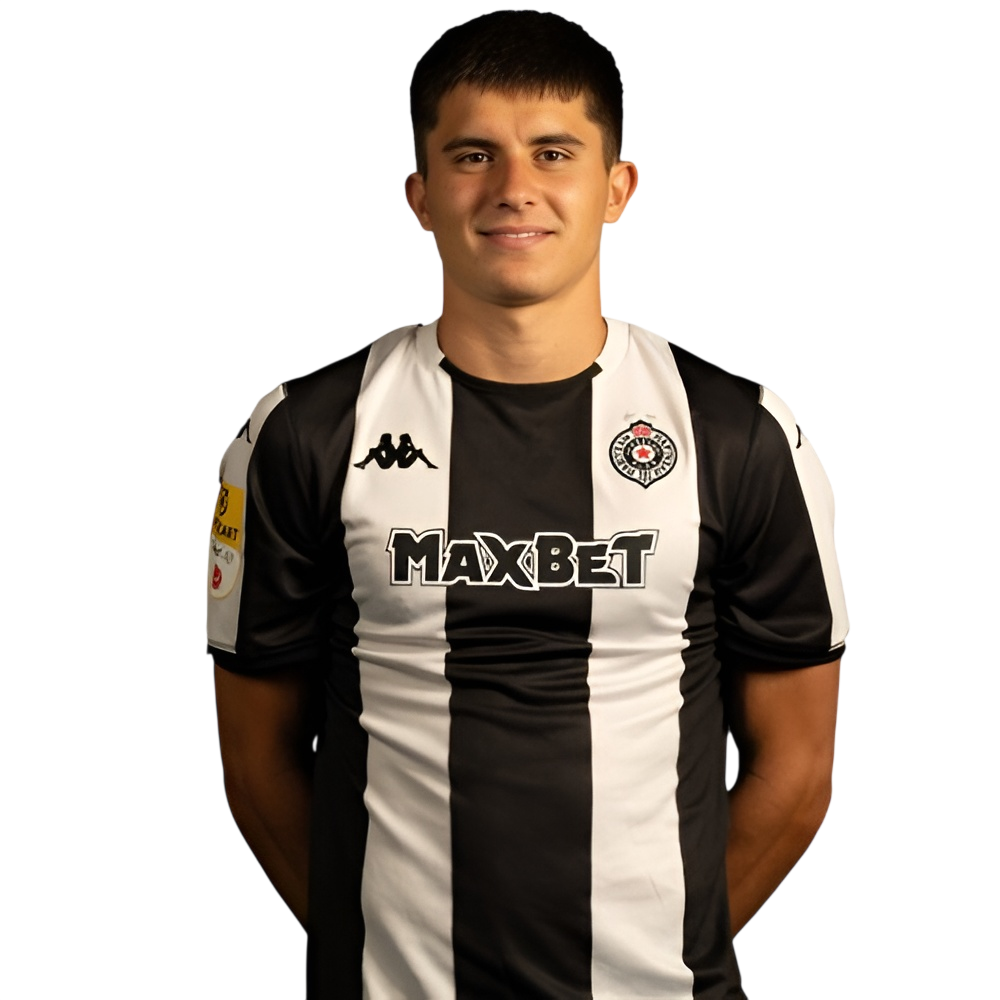
Buy the distribution intelligence and the defensive reading. Manage the duel rate gap and the system dependency with the right partner alongside him. The profile needs a specific structural environment — a double pivot with a physically dominant partner, wide runners to reduce carrying demands, a possession base that gives the long ball time to develop. Inside that environment, the ceiling is a genuine top-level European DM. Outside it, the gaps become the story instead.
Projects as a reliable first-choice DM at a top-division club in the Bundesliga or Serie A. The ceiling moves toward 8 if the duel rate and close control develop and the progressive carry range improves. The floor is a very useful structured pivot midfielder whose distribution quality consistently raises the tempo of his team's transitions. At €6M, the floor alone is worth the price.